DRAVION · AI CODE PLATFORM
From rough idea to deploy-ready code.
A supervised autonomous engineering cockpit. You describe the work; a Manager Agent plans it and a fleet of workers ships it.
you
Add rate limiting to the API and write tests.
manager-agent
Spawning 2 workers…
worker-1 · docker:sandbox-8f2a
✓ committed a41c9e
worker-2 · docker:sandbox-c31b
✓ wrote rateLimit.test.ts ✓ all green ✓ committed 7d02f3
One conversation.
You talk to a single Manager Agent. It asks what's missing, breaks the request down, delegates, and reports back.
Isolated sandboxes.
Every worker runs in its own Docker container — reading and writing files, running terminal commands, committing code.
Supervised, not blind.
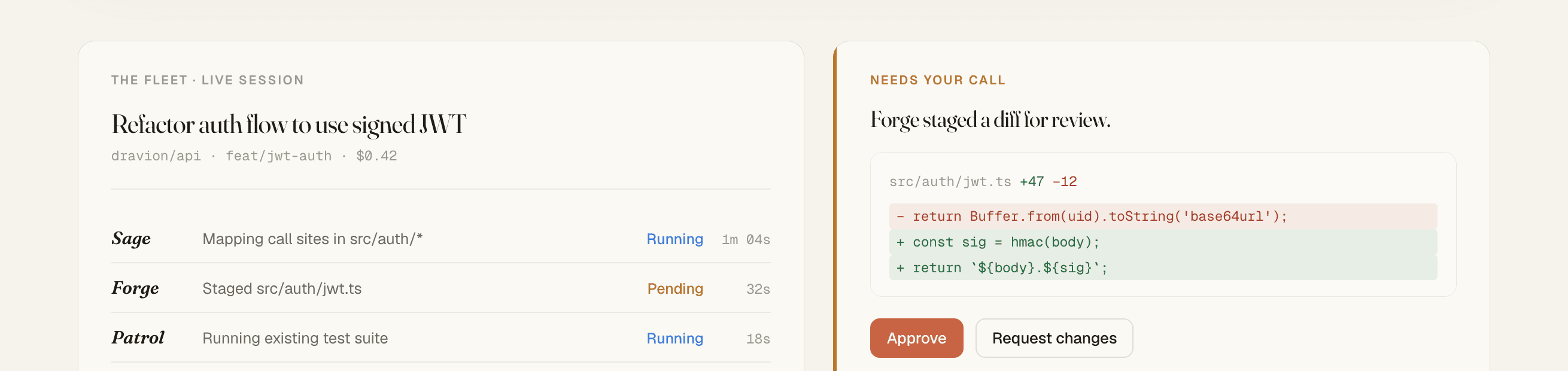
Agents plan, write, test and commit on their own — but the roadmap and the diff are yours to review. Not an AI-assisted editor.
THE HARD PART
Sandbox isolation.
Terminal commands never run on the host — every worker gets a Docker sandbox with a node-pty shell and no path to another worker's filesystem. Drawing that boundary tightly enough to trust, and loosely enough to be useful, was the hardest problem in the build.
Secret handling.
Users bring their own model keys, so the blast radius of a mistake is somebody else's account. Keys are sealed with AES-256-GCM behind a rotatable master key, orchestrator jobs are HMAC-signed, and every read or write is row-scoped to its owner.
Orchestration.
Agents are stateless; the truth lives in the queue and the database. Most of the engineering is not the model call — it is what happens when step four fails and steps five and six already assumed it passed.
MEASURABLE AUTONOMY
Autonomy you can't measure is a demo. Autonomy you can measure is a product.
Deterministic replay
Every agent turn writes a reproducible record, so a run can be replayed instead of retold.
Versioned failure taxonomy
Failures carry a category tag, which turns "it broke" into a rate you can watch move.
Continuous eval gate
Releases pass an automated evaluation before shipping — replay success rate is a release blocker, not a slide.
STRIDE threat modelAppend-only audit hash chainAES-256-GCM at restOpenTelemetry tracingZod-validated boundariesVitest · Playwright · axe-coreTypeScript strict — no any
Next.js 15TypeScriptPostgreSQL + pgvectorDrizzleBullMQ + RedisDockerOpenTelemetry